
A few weeks ago I sat down with a customer. He opened a spreadsheet and said: “Really, we should just digitise this spreadsheet.”
It was about a procurement process. Employees entered their requirements in a spreadsheet — line items, amounts, dropdowns — and at the end, a button triggered an email requesting approval. Actually already fairly digital.
I only asked one question: “What happens after that click?”
The real process
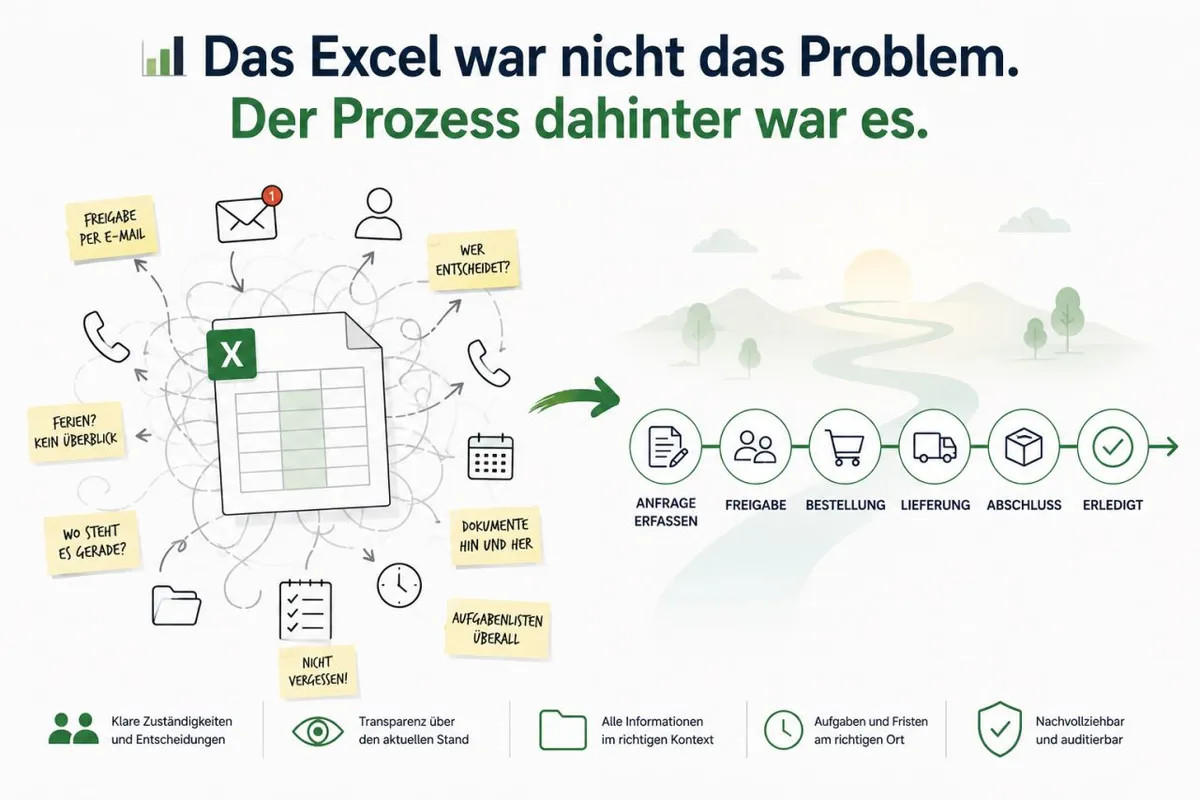
And suddenly the actual process came into view:
- A manager had to approve it.
- Depending on the amount, further approvals were needed.
- Purchasing was waiting for information.
- Follow-up questions went back and forth by email or phone.
- Quotes and documents were exchanged.
- The order had to be placed.
- Delivery dates had to be clarified.
- Reminders ended up in Outlook or on personal to-do lists.
- And when someone was on holiday, sometimes nobody knew where things stood.
The spreadsheet was never the problem. Behind it were decisions, responsibilities, communication, approvals, tasks, deadlines and documents.
Digital, but not digitally organised
Here’s the interesting part: the process was already digital — just not digitally organised. The spreadsheet managed the data, email carried the approvals, Outlook reminded people of deadlines, personal lists tracked open items. And the employees made sure it all held together in the end.
If we had simply replaced the spreadsheet with a web form, that would have been more modern. But barely better — a digital form doesn’t automatically make a digital process.
So we asked first:
- Who does what?
- Who decides?
- What happens next?
- What information is needed?
- What can be automated?
- What needs to stay traceable?
Where easydoo comes in
This is exactly where easydoo comes in. easydoo doesn’t just replace a spreadsheet with a form — it maps the work around the information. A procurement request becomes a continuous process: from raising the need, through approvals and ordering, to delivery. Tasks, responsibilities, deadlines, documents and communication stay in the right context — everyone involved can see where things stand and what needs to happen next.
That’s exactly what we at easydoo mean by work organisation.
More than just a file
Spreadsheets are often long since more than files — they are work organisation that has grown over years. But the knowledge behind them often sits inside the spreadsheet itself, or in the heads of individual people. Automation and transparency stay limited, and as soon as several people or departments are involved, the spreadsheet quickly becomes a bottleneck.
Not because spreadsheets are bad. But because a spreadsheet was never meant to carry a company’s entire work organisation.
Which spreadsheet in your company has long since become more than just a file?