
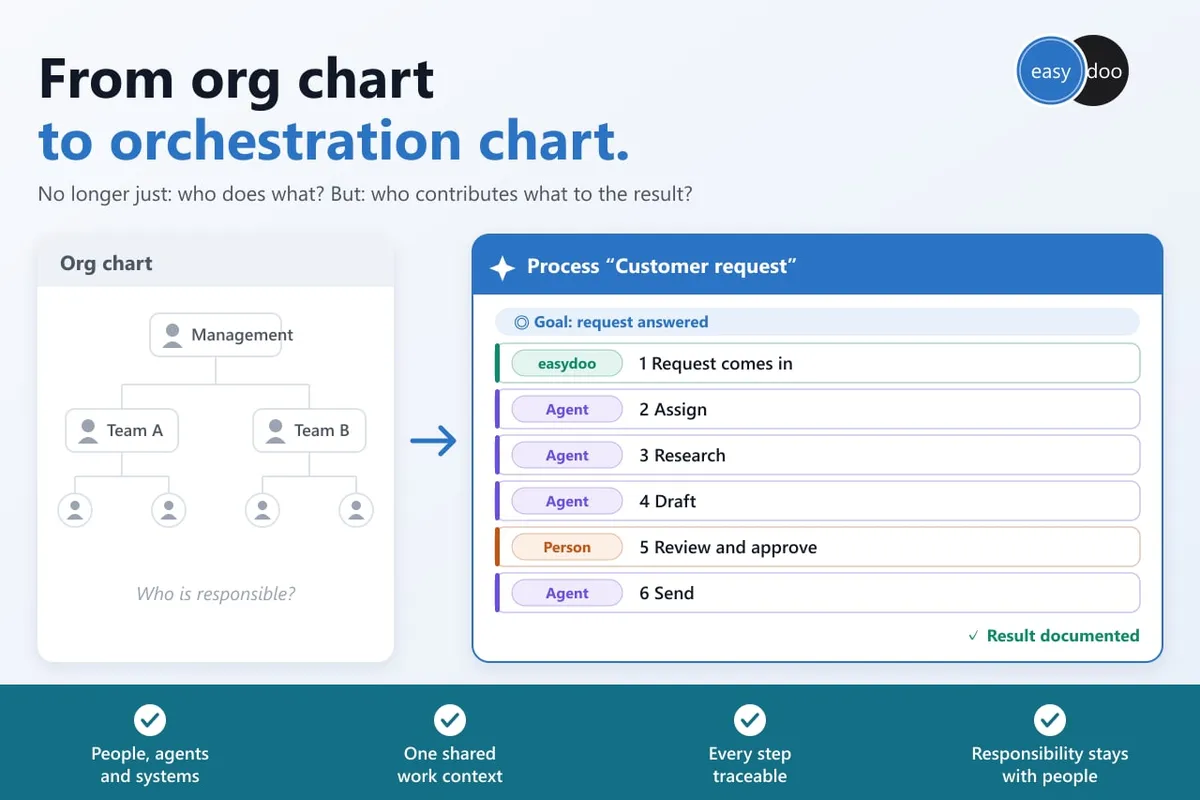
An org chart answers a simple question: who is responsible for what?
For a long time, that was enough. Work was done by people, and processes described the order in which it happened. With AI agents, a new participant joins — and the question shifts.
From who to how
McKinsey recently used a fitting term for this: the orchestration chart. Organisations should no longer only ask which person takes on which task, but which combination of people and agents produces a desired outcome.
Until now, it looked like this:
Process → task → employee
In future, more like this:
Goal → process → person, agent or system → result
An agent belongs in the process, not beside it
What this means in practice shows up in a perfectly ordinary customer request. The request comes in, an agent assigns it, researches earlier orders and documents and writes a draft. The responsible person reviews and approves it. The agent then sends the reply, and the result is recorded in the work item.
What matters to me: the agent does not work somewhere outside, in a separate tool whose results you have to gather up afterwards. It is a participant in the process — with a clearly assigned user, defined permissions and a log of what it has done.
The organisation needs a foundation for this
For people and agents to work together, both need the same thing: a shared work context. Who is the customer? Which orders are running? What was decided, and by whom? Which documents belong to it?
That has always been the core of easydoo. Work items, processes, responsibilities, permissions and documents are connected. For an agent, that is the difference between “a few search hits” and “understanding what it is about”.
Responsibility stays with people
An orchestration chart does not mean that responsibility moves to the AI. An agent can take on a work step like a team member. A person remains responsible for the result and the approval — and the process defines where that decision is needed.
AI does not make work organisation disappear. It makes it more important.