
“Can easydoo do AI?”
I hear this question in almost every conversation now. My answer: yes. But I think the more important question is how AI takes part in work organisation.
No second layer next to the work
Many people picture AI as something that runs somewhere alongside the actual work: an assistant does something, and afterwards nobody quite knows what happened.
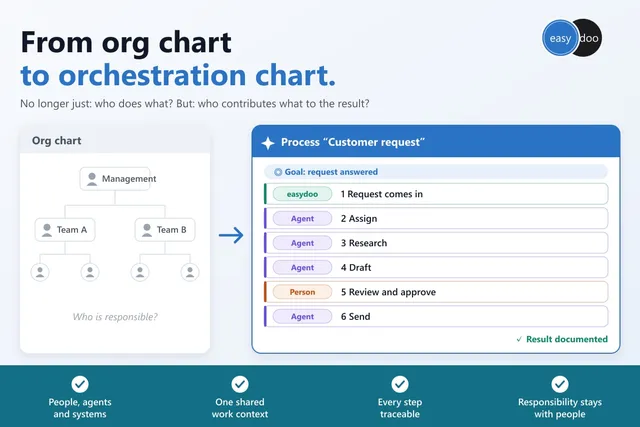
To me, that is the wrong approach. When an AI plans or documents in easydoo, it does so exactly the way a person would have to: in the same work items, with the same work steps, appointments and permissions. What it changes is visible in the work context and in the history. Responsibility for a work item stays with a person.
An example from my day-to-day work
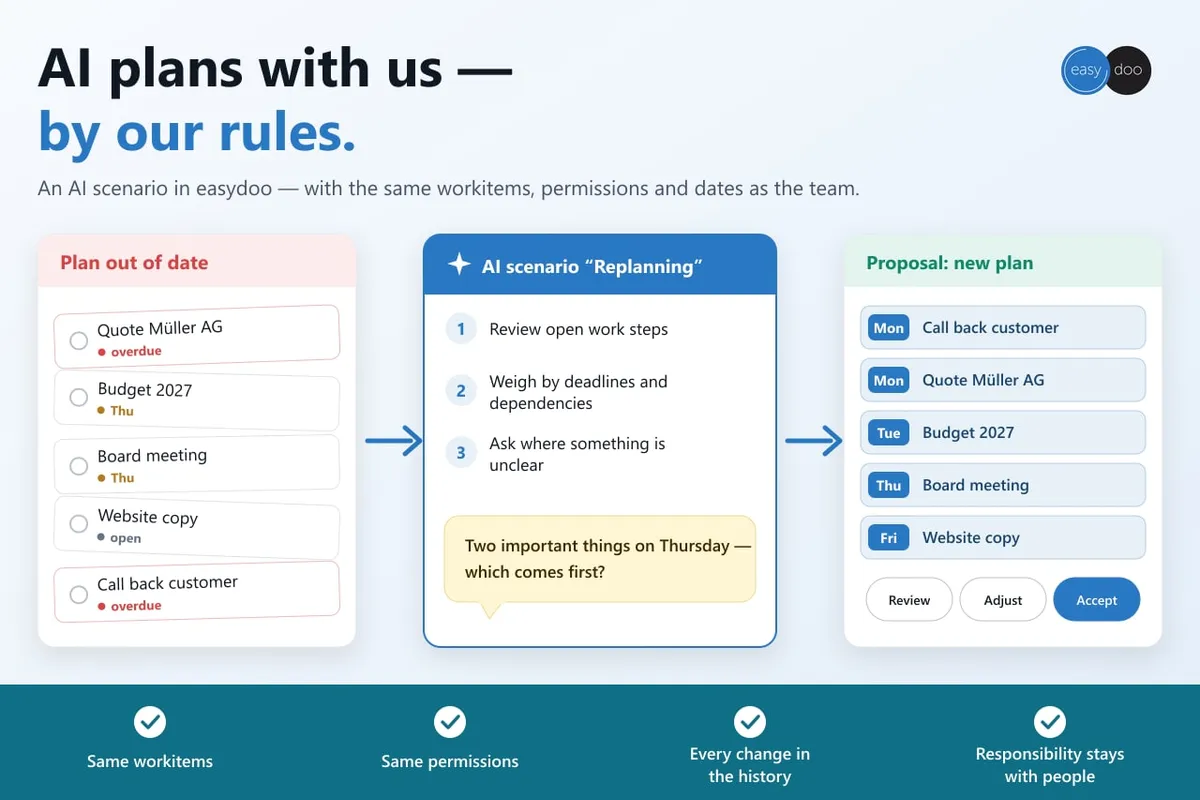
After a week full of interruptions, my plan is often out of date. That used to mean going through all open assignments, comparing deadlines and re-sorting everything.
Today I start the AI scenario “Re-planning” in easydoo — one of the prepared scenarios that come with easydoo. The AI goes through my open work steps, weighs them by deadlines and dependencies, and asks where something is unclear — for example when two important things are due on the same day. Then it proposes a new plan.
What matters: the result is a perfectly normal easydoo plan. I review it, adjust it, apply it — and my team sees the same appointments and steps as if I had planned them myself.
I decide where AI works
Not every task should be taken over by AI. Where it makes sense, I use a prepared AI scenario or define my own, with the AI of my choice and with exactly the permissions it needs. Where it doesn’t, I work as before.
AI may take over work. But it must never be a black box.